Review of The Calculating Stars, by Mary Robinette Kowal

The Calculating Stars

by Mary Robinette Kowal

Tom Doherty Associates, 2018. 431 pages.
Review written September 3, 2021, from my own copy purchased via amazon.com
Starred Review

I tend to love novels where the main character is a mathematician, and when that main character is a woman, that love goes over the top.

The Calculating Stars is set in 1952, featuring Elma, a woman who was a WASP pilot and now works as a computer for NACA, the National Advisory Committee for Aeronautics. Her husband is a lead engineer for NACA.

Yes, this is a different timeline from the one we’re living in – and as the book begins, a meteorite strikes the earth, landing in the Chesapeake Bay outside Washington, DC – which is completely wiped out.

Elma and Nathaniel are in the Poconos when the meteorite strikes. I love the way they both know enough about explosions to know it is not an atomic bomb because the radio continues to play, so they know there wasn’t an electromagnetic pulse. Since an earthquake hits four minutes later, they figure out it was a meteorite and know to get to shelter before an air blast hits. This tells the reader these are highly intelligent scientists – but in an extremely tense scenario.

When they do get to safety, after much difficulty, much of the East Coast has been obliterated. As Elma is doing calculations to figure out what the meteorite was made of – she realizes that earth is in trouble. After some years of extreme cold, things are going to heat up until earth is uninhabitable.

So the rest of the book happens in 1956 and is about the push to go into space – much more quickly than happened in our timeline. Because if those calculations are correct, humans are going to need to build colonies off our home planet.

Elma is an experienced pilot and a genius mathematician – but it’s 1956, and she’s a woman. Many believe that a woman’s place is in the home. Can she prove she has what it takes to become an astronaut? And doesn’t anybody understand they’re going to need women in space to establish colonies, anyway?

This book had me following the gripping storyline all the way through. Elma’s voice telling the story is practical but engaging. I love the way she built in actual things about the space program in our timeline – for example that engineers were male but human computers were female – and that women were allowed to train to be astronauts but were not accepted – and the discrimination that was prevalent at that time. All of this is built into what feels like a very realistic story.

It was disconcerting to read about a disaster that would render earth uninhabitable at the same time fires are raging and huge hurricanes are striking and a pandemic is killing people all over the world. I thought it was just as well she set the disaster in the past so it didn’t feel like something that might soon happen. I could reassure myself this was just fiction!

One thing puzzled me a little after I finished the book. Elma and her husband are young and healthy, and they have lots of sex throughout the book. The book covers five years, but Elma never gets pregnant. Perhaps she’s on birth control pills (maybe developed earlier in that alternate reality?), but she sees a doctor and doesn’t talk about that. And medication for anxiety becomes a big issue for her career. Plus at one point she vomits from anxiety and her husband thinks she’s pregnant, but she tells him she just had her period a week ago. If they’re taking steps not to be pregnant, why would he think that, but if they’re not taking steps, why aren’t they concerned? The book covers five years, so I’d expect a young married couple having lots of sex to be thinking about this issue, one way or another. And especially if they’re living in the 1950s. And even more so if they’re making the case that women need to go into space to help build a colony. Perhaps this will be an issue, one way or the other, in later books.

But that’s a minor quibble. The only time it occurred to me when I was reading the book was when I was puzzled the husband thought she was pregnant. By then, I’d assumed there were strong reasons she wasn’t.

One thing I do know: I want to read the next two books in the series. I’m hoping the lady astronauts will help save mankind.

maryrobinettekowal.com
us.macmillan.com/tomdohertyassociates

Buy from Amazon.com

Find this review on Sonderbooks at: www.sonderbooks.com/Fiction/calculating_stars.html

Disclosure: I am an Amazon Affiliate, and will earn a small percentage if you order a book on Amazon after clicking through from my site.

Disclaimer: I am a professional librarian, but I maintain my website and blogs on my own time. The views expressed are solely my own, and in no way represent the official views of my employer or of any committee or group of which I am part.

What did you think of this book?
Review of Powwow, by Karen Pheasant-Neganigwane

Powwow

A Celebration through Song and Dance

by Karen Pheasant-Neganigwane

Orca Book Publishers, 2020. 82 pages.
Review written June 12, 2020, from a library book

This lovely book, which is lavishly illustrated with colorful photographs – explains the history of Powows, their important place in Indigenous culture, and the author’s own experiences with them.

I didn’t realize that they are a relatively new kind of celebration, although based on traditional dances that were almost lost.

The chapter “The Origins of Powwow Culture” begins this way:

The first powwow that took place on my home reserve, Wiikwemkoong, was in 1960. Powwow culture was quite new to Indigenous communities back then, because until 1951 it had been illegal for Indigenous Peoples in Canada to practice their culture and ceremonies, which included dance. As well, because my parents had attended Indian residential school, where they were always shamed for their Indigenous identity, there wasn’t much Indigenous culture or tradition in my home. As a young child, before I went to the powwows, my only understanding of what Indian meant was from those Hollywood “cowboy-and-Indian” shows on TV.

She explains how the governments of Canada and the United States made it illegal to celebrate Indigenous traditions and tried to force Indigenous peoples to assimilate and become like the people around them. Some native ceremonies and traditions were lost or almost lost.

She explains how powwows began as those laws were relaxed, and they continued to evolve.

Powwow culture has changed a lot in the last few decades, and there are now many different kinds of powwows, from smaller, traditional, local ones held on reserves and reservations to large competition powwows that take place in stadiums and casinos.

Traditional powwows don’t cost anything to attend. Competition powwows sometimes charge an admission fee. Some powwows focus just on the songs and dances, but others include other activities, like rodeos, fashion shows, music awards, midway rides and dance “specials” – exhibitions of dances from specific regions or peoples. But no matter how small or large the powwow, it is still the same in spirit. It’s still a celebration through song and dance, and it’s public and open to anyone, even people who have no experience. People go to powwows to have a good time – to hear the songs and dance or watch the dancers, see friends, share meals, tell stories and remember the past.

I especially enjoyed the chapter on certain traditional types of dances that are regularly performed at powwows. Most of them are specifically for different groups of people, for example Women’s Traditional Dance, Women’s Fancy Shawl Dance, and Women’s Jingle Dress Dance. Not only in this chapter, but throughout the book are wonderful photos of beautiful outfits worn for these dances. There’s a chapter about other things you’ll find at powwows and traditions for powwows in different regions.

I actually once attended a powwow – in Germany, of all places. I wish I’d had this book then, to better understand what I was seeing. Whether you can attend a powwow or not, this book offers upper elementary children and up a beautiful celebration of Indigenous culture and traditions.

orcabook.com

Buy from Amazon.com

This review is only on the blog.

Disclosure: I am an Amazon Affiliate, and will earn a small percentage if you order a book on Amazon after clicking through from my site.

Source: This review is based on a library book from Fairfax County Public Library.

Disclaimer: I am a professional librarian, but the views expressed are solely my own, and in no way represent the official views of my employer or of any committee or group of which I am part.

What did you think of this book?

Review of It’s a Numbers Game! Baseball, by James Buckley, Jr.

It’s a Numbers Game!

Baseball

by James Buckley, Jr.

National Geographic Kids, 2021. 128 pages.
Review written January 6, 2022, from my own copy, purchased for the Mathical awards.
Starred Review
2022 Mathical Honor Book, Grades 6-8

Math and baseball! It’s a natural pairing, and this book explores all the connections, inviting readers in with plenty of action shots on every page.

Did you know that Major League Baseball teams now hire mathematicians? There’s a spread titled “Averages Your Grandparents Know” about Pitching stats of ERA, WPCT, and WHIP. Then comes a spread called “Averages Your Grandparents (Probably) Don’t Know,” and I was a little chagrined that I fit a reader’s grandparents. But that second spread had some interesting information:

There are a lot of stats you can calculate on your own. But for some of these stats, it’s as if you need an advanced math degree to understand them! In fact, many MLB teams now employ professional mathematicians. Every MLB team has a special department that does nothing but crunch numbers. Called sports analytics, these calculations and stats are changing how players are selected and sometimes even how the game is played.

On another page I learned about a new tool used since 2015:

In recent seasons, MLB started using a new way of tracking and measuring home runs. Cameras track every movement of the ball, and computers quickly calculate information using a system called Statcast. As players and coaches study the Statcast data, they develop new ways to go after the long ball.

With statcast, they can find and report the launch angle, the speed, and the actual distance a home run ball will travel. For pitchers, they now have a much more accurate measure of the speed of a pitch and can even tell you the spin rate.

That’s some of the interesting information found in this book packed with information about baseball and every kind of statistic you can imagine. My older brother was a big Angels fan and very interested in the statistics, so I thought I would know most of what’s in this book, but it turned out to be only the part your grandparents would know!

The book does say a little bit about women’s softball, about Little League, and about baseball in other countries, but this is mostly a book about Major League Baseball. I do like, though, that each chapter has something for the reader to try. It’s usually related to statistics, but also pertaining to what the chapter discussed. Kids will learn to keep score and to read a box score, for example.

This book is packed with the numbers of baseball, including stats and records, and even numbers on jerseys that have been retired. It’s all done in an inviting format, with colors and pictures and charts. The text is in small chunks, and each page is visually interesting. I was much more engaged than I had expected to be, since I haven’t watched baseball in years.

This book will intrigue both kids who love sports and kids who love numbers, and perhaps help build overlap between those groups!

natgeokids.com

Buy from Amazon.com

Find this review on Sonderbooks at: www.sonderbooks.com/Childrens_Nonfiction/numbers_game.html

Disclosure: I am an Amazon Affiliate, and will earn a small percentage if you order a book on Amazon after clicking through from my site.

Disclaimer: I am a professional librarian, but the views expressed are solely my own, and in no way represent the official views of my employer or of any committee or group of which I am part.

What did you think of this book?

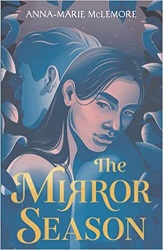
Review of The Mirror Season, by Anna-Marie McLemore

The Mirror Season

by Anna-Marie McLemore

Feiwel and Friends (Macmillan), 2021. 311 pages.
Review written January 15, 2022, from a library book
Starred Review
2022 Cybils Finalist, Young Adult Speculative Fiction

Wow. This book is transcendent and magical. But also horribly tough.

It begins with a warning. I’ll include it as well:

This book contains discussions of sexual assault and PTSD. If you or someone you know has been sexually assaulted, please know that there’s help, and there’s hope.

If you don’t know where to start, start with RAINN: rain.org/resources or (800)656-4673.

So, yes, this book involves sexual assault. As the book opens, Ciela is taking a boy to the hospital. She doesn’t know his name or even where he’s from. She tells the nurse, “They drugged him. We were at a party.” And then she gets out of there before the police show up. She knows he’ll have to wake up alone, knowing only that something bad happened to him. But she can’t stay.

And on the way back to her car, she sees a rose turn to mirrored glass. As she reaches for it, it shatters, and a shard gets into her eye. And as the days go by, she can feel its hard cold glass going into her heart.

And something bad happened to Ciela, too. Something so bad, she’s not yet ready to even tell herself exactly what happened. And she feels responsible for what happened to the boy, who turns out to be a new kid at her private school, on scholarship like she is.

Ciela works at her families pastelería. She has always been able to tell what pan dulce a customer wants or needs before they ask, inheriting that magic from her great-grandmother. But since the party, that ability is gone. And she keeps seeing flowers turn into mirrors. She wants to save anyone else from having one of those sharp pieces get into their heart.

This isn’t a retelling of The Snow Queen, but it has echoes of the Hans Christian Anderson story. The book is set in San Juan Capistrano, and the swallows, too, have a role in the story.

I usually have trouble with magical realism – I like my magic logical and orderly. But Anna-Marie McLemore has a deft hand, and I discovered that symbolism is the perfect way to deal with trauma and its aftermath. The magic in this book is powerful and helps Ciela reclaim her own body and find her voice and her gifts again.

Yes, this book deals with hard things and frightful events. But there’s healing and compassion here. The healing isn’t instant, and the trauma leaves marks, but it’s all helped along by magic, transforming about a book about something awful into one of the loveliest books I’ve read in a long time.

fiercereads.com

Buy from Amazon.com

Find this review on Sonderbooks at: www.sonderbooks.com/Teens/mirror_season.html

Disclosure: I am an Amazon Affiliate, and will earn a small percentage if you order a book on Amazon after clicking through from my site.

Disclaimer: I am a professional librarian, but the views expressed are solely my own, and in no way represent the official views of my employer or of any committee or group of which I am part.

What did you think of this book?

Review of What Will Fit? by Grace Lin

What Will Fit?

by Grace Lin

Charlesbridge, 2020. 16 pages.
Review written September 30, 2021, from my own copy ordered via Amazon.com
Starred Review

What Will Fit? is a board book in Charlesbridge’s wonderful “Storytelling Math” series.

This one is perfect – exploring spatial relationships in a way that is vitally interesting to the toddlers it’s written for.

The story is board-book simple. We’ve got a little girl going to the farmer’s market with a basket. She wants to find something that fits just right in her basket. She looks at a beet, an apple, a zucchini (turned both ways), and an eggplant.

Finally, she finds a pumpkin just the right size and celebrates.

On the back spread are notes to parents with playful ways you can build your child’s spatial sense.

The package all adds up to a sweet little story for short attention spans that will springboard into conversations that will help children learn an important concept fundamental to mathematical understanding. And all in a way that is interesting to them.

gracelin.com
charlesbridge.com/storytellingmath

Buy from Amazon.com

Find this review on Sonderbooks at: www.sonderbooks.com/Picture_Books/what_will_fit.html

Disclosure: I am an Amazon Affiliate, and will earn a small percentage if you order a book on Amazon after clicking through from my site.

Disclaimer: I am a professional librarian, but the views expressed are solely my own, and in no way represent the official views of my employer or of any committee or group of which I am part.

What did you think of this book?

Review of On Tyranny, by Timothy Snyder, illustrated by Nora Krug

On Tyranny

Twenty Lessons from the Twentieth Century

Graphic Edition

by Timothy Snyder
illustrated by Nora Krug

Ten Speed Press, 2021. Original edition published in 2017. 128 pages.
Review written January 6, 2022, from a library book
Starred Review

I think copying out the Prologue will explain well what this book is trying to do:

History does not repeat, but it does instruct. As the Founding Fathers debated our Constitution, they took instruction from the history they knew. Concerned that the democratic republic they envisioned would collapse, they contemplated the descent of ancient democracies and republics into oligarchy and empire. As they knew, Aristotle warned that inequality brought instability, while Plato believed that demagogues exploited free speech to install themselves as tyrants. In founding a democratic republic upon law and establishing a system of checks and balances, the Founding Fathers sought to avoid the evil that they, like the ancient philosophers, called TYRANNY. They had in mind the usurpation of power by a single individual or group, or the circumvention of law by rulers for their own benefit.

Much of the succeeding political debate in the United States has concerned the problem of tyranny within American society: over slaves and women, for example.

It is thus a primary American tradition to consider history when our political order seems imperiled. If we worry today that the American experiment is threatened by tyranny, we can follow the example of the Founding Fathers and contemplate the history of other democracies and republics. The good news is that we can draw upon more recent and relevant examples than ancient Greece and Rome. The bad news is that the history of modern democracy is also one of decline and fall. Since the American colonies declared their independence from a British monarchy that the Founders deemed “tyrannical,” European history has seen three major democratic moments: after the First World War in 1918, after the Second World War in 1945, and after the end of communism in 1989. Many of the democracies founded at these junctures failed, in circumstances that in some important respects resemble our own.

He continues to talk about the rise of fascism, Nazism, and communism in the twentieth century.

We might be tempted to think that our democratic heritage automatically protects us from such threats. This is a misguided reflex. In fact, the precedent set by the Founders demands that we examine history to understand the deep sources of tyranny, and to consider the proper responses to it. Americans today are no wiser than the Europeans who saw democracy yield to fascism, Nazism, or communism in the twentieth century. Our one advantage is that we might learn from their experience. Now is a good time to do so.

This book presents twenty lessons from the twentieth century, adapted to the circumstances of today.

The first lesson is “Do not obey in advance.” The first example is that several countries taken over by Hitler started persecuting Jews before they were ordered to.

Some other notable lessons are: “Remember professional ethics.” (Doctors should not be willing to experiment on prisoners, for example.) “Be wary of paramilitaries.” “Be reflective if you must be armed.” “Be kind to our language.” “Believe in truth.” “Learn from peers in other countries.” “Listen for dangerous words.”

The lesson “Be a patriot.” contrasts patriotism with nationalism. “A nationalist encourages us to be our worst, and then tells us that we are the best.”

A patriot, by contrast, wants the nation to live up to its ideals, which means asking us to be our best selves. A patriot must be concerned with the real world, which is the only place where their country can be loved and sustained. A patriot has universal values, standards by which they judge their nation, always wishing it well – and wishing that it would do better.

The Epilogue contrasts the politics of inevitability, eternity, and history.

The politics of inevitability is “the sense that history could move in only one direction: toward liberal democracy.” Communism had a similar politics of inevitability, though theirs was that history was moving toward an inevitable socialist utopia.

The politics of eternity are “concerned with the past, but in a self-absorbed way, free of any real concern with facts. Its mood is a longing for past moments that never really happened during epochs that were, in fact, disastrous.”

Eternity politicians bring us the past as a vast misty courtyard of illegible monuments to national victimhood, all of them equally distant from the present, all of them equally accessible for manipulation. Every reference to the past seems to involve an attack by some external enemy upon the purity of the nation. National populists are eternity politicians.

I was a little surprised that his first examples of that were politicians advocating for Brexit in the United Kingdom and the National Rally in France. But yes, he does include “Make America great again.”

He says it’s easy to go from the politics of inevitability to the politics of eternity.

The only thing that stands between them is history itself. History allows us to see patterns and make judgments. It sketches for us the structures within which we can seek freedom. It reveals moments, each one of them different, none entirely unique. To understand one moment is to see the possibility of being the cocreator of another. History permits us to be responsible: not for everything, but for something.

The illustrator put many photographs from tyrannies in the twentieth century in these pages, along with disturbing images that will help the words strike home. The book was clearly updated in 2021, since it includes many statements from the Trump presidency and the events of January 6, 2021.

The result is a powerful book of history with warnings for today.

tenspeed.com

Buy from Amazon.com

Find this review on Sonderbooks at: www.sonderbooks.com/Nonfiction/on_tyranny.html

Disclosure: I am an Amazon Affiliate, and will earn a small percentage if you order a book on Amazon after clicking through from my site.

Disclaimer: I am a professional librarian, but the views expressed are solely my own, and in no way represent the official views of my employer or of any committee or group of which I am part.

What did you think of this book?

Review of Fly, Girl, Fly! by Nancy Roe Pimm, illustrated by Alexandra Bye

Fly, Girl, Fly!

Shaesta Waiz Soars Around the World

by Nancy Roe Pimm
illustrated by Alexandra Bye

Beaming Books, Minneapolis, 2020. 44 pages.
Review written November 14, 2020, from a library book

This picture book biography tells the story of Shaesta Waiz, who was born in Afghanistan and came to America as a refugee with her family when she was a little girl. As a child, she had a lot of fears, including a fear of riding in an airplane. But after overcoming that fear on a trip to see her cousin in Florida, Shaesta decided to become a pilot.

Shaesta went on to fly solo around the world. But she made her trip distinctive by making many stops along the way to speak to girls about all that they can grow up to accomplish, including a stop in her native Afghanistan.

Shaesta decided she would not just fly all the way around the world. She’d also meet with young people everywhere. She’d get them excited about careers in science, technology, engineering, and math to chase down dreams of their own!

Shaesta ended up being the first woman from Afghanistan and the youngest woman in history to fly a single-engine aircraft around the world.

This is a fascinating and inspiring story about someone I wouldn’t have heard of otherwise. It’s great to read about a refugee girl who followed her dreams and did something big.

beamingbooks.com

Buy from Amazon.com

This review is only on the blog.

Disclosure: I am an Amazon Affiliate, and will earn a small percentage if you order a book on Amazon after clicking through from my site.

Disclaimer: I am a professional librarian, but the views expressed are solely my own, and in no way represent the official views of my employer or of any committee or group of which I am part.

What did you think of this book?

Review of Too Bright to See, by Kyle Lukoff

Too Bright to See

by Kyle Lukoff

Dial Books for Young Readers, 2021. 188 pages.
Review written February 19, 2022, from a library book
Starred Review
2021 National Book Award Finalist
2021 Cybils Finalist, Elementary/Middle Grade Speculative Fiction
2022 Stonewall Award Winner
2022 Newbery Honor Book

Too Bright to See is a ghost story, but I don’t have a Paranormal category in my Children’s Fiction page, so I think I’ll list it under “Contemporary” rather than under “Fantasy,” because it’s a Contemporary story that also has ghosts. This is the first Stonewall Award Winner (for LGBTQ-content books) to also receive Newbery recognition, and the first transgender author to receive Newbery recognition. When I was talking about the book to coworkers I said, sadly only half-joking, to read it before it gets banned. (The question is, how current are the book banners? Do they realize new children’s books are being published all the time?)

The story is simple and heart-warming. As it begins a kid called Bug is dealing with the recent loss of their uncle. They had lived with their mother and uncle in an old haunted house in Vermont. Bug has always been able to sense ghosts in the house — cold spots and unexplained winds and the like. But the ghosts had never paid any attention to Bug — until now.

Bug becomes convinced their uncle is trying to tell them something. But how can they figure out what? In the meantime, Bug’s best and only friend Mo wants to get ready for middle school. She asks to be called Moira and buys fancier clothes and starts practicing wearing makeup and nail polish. Bug wants no part of it, but wonders if something is wrong that they feel that way.

Knowing the author is trans, I was pretty sure where this plot was going, and I wasn’t wrong. But I did think it was handled in a nice way. And those around Bug handled it well, too, in a book about middle school approaching that was refreshingly free from bullying. This is how such a thing should go — and how nice to read such a book.

But all you need to tell kids is that this book is about “a kid being haunted by the ghost of their dead uncle into figuring out something important.” That’s how the author summarizes the plot. I’m not a big ghost story fan, but this book will work for kids who like very gentle hauntings. And of course any book about middle school approaching is going to deal with friendships and family and adjustments and about figuring out who you really are in the context of all that. This book does not disappoint.

kylelukoff.com
penguin.com/kids

Buy from Amazon.com

Find this review on Sonderbooks at: www.sonderbooks.com/Childrens_Fiction/too_bright_to_see.html

Disclosure: I am an Amazon Affiliate, and will earn a small percentage if you order a book on Amazon after clicking through from my site.

Disclaimer: I am a professional librarian, but the views expressed are solely my own, and in no way represent the official views of my employer or of any committee or group of which I am part.

What did you think of this book?

Review of Fallout, by Steve Sheinkin, read by Roy Samuelson

Fallout

Spies, Superbombs, and the Ultimate Cold War Showdown

by Steve Sheinkin
read by Roy Samuelson

Listening Library, 2021. 8 hours
Review written 2/22/22 from a library eaudiobook
Starred Review
2022 Young Adult Excellence in Nonfiction Award Finalist

Fallout is a nonfiction book about the Cold War, leading up to the Cuban Missile Crisis. Steve Sheinkin takes a storyteller’s approach, telling you the stories of key figures, including many I’d never heard of before. Among others, these included a U2 pilot who got shot down over Russia, a Russian spy who tried to establish a network in New York City beginning soon after World War II, a paper boy who found a nickel that had been hollowed out to hold microfilm, and a Russian chief of staff of a submarine fleet who ordered a submarine captain and first officer not to launch a nuclear torpedo — after the world thought hostilities were ended, but the sub hadn’t heard about it.

The book is gripping and engaging and full of facts from witnesses. Although it takes place before I was born, I remember the climate when nuclear war seemed highly likely, even doing a drop and cover drill at my desk as a child, and being told by my parents that you could never trust the Russians.

Steve Sheinkin begins right after World War II and the development of bombs whose destructive force is hard to even imagine. He progresses through the space race and the rise of Castro and the development of the U2 program to fly over the Soviet Union. We hear about Khruschev’s ruthless rise to power as well as John F. Kennedy’s.

The one catch to this amazing audiobook is that my timing wasn’t good. I listened to it as Putin was threatening to invade Ukraine. Learning how several lucky coincidences saved us from World War III during the Cuban Missile Crisis, and learning that all-out nuclear war would mean the end of human life on earth as we know it — all made it disturbing to have Russia threatening war again, even in a different part of the world.

stevesheinkin.com
listeninglibrary.com

Buy from Amazon.com

Find this review on Sonderbooks at: www.sonderbooks.com/Teen_Nonfiction/fallout.html

Disclosure: I am an Amazon Affiliate, and will earn a small percentage if you order a book on Amazon after clicking through from my site.

Disclaimer: I am a professional librarian, but the views expressed are solely my own, and in no way represent the official views of my employer or of any committee or group of which I am part.

What did you think of this book?

Review of All the Greys on Greene Street, by Laura Tucker

All the Greys on Greene Street

by Laura Tucker

Viking, 2019. 307 pages.
Review written January 9, 2020, from a library book

All the Greys on Greene Street is set in Soho in 1981, and tells the story of twelve-year-old Olympia. Olympia is an artist, and she likes to sketch in grey. Both her parents are artists – her mother makes sculptures from found objects, and her father restores old works of art.na

But recently Olympia’s life has been uprooted. Her father ran off to France a week ago with a Frenchwoman he was working with, and her mother has gone to bed – and won’t get up.

The family lives in a loft in the same building as their studio, and her father’s partner is still working there. This book is the story of Olympia’s carrying on – and still making art – while no one is taking care of her. Her mother had an episode like this before, and Olympia’s not sure what she’ll do if she tells anyone. Her father is unreachable and left a note that some people think what he did was wrong – there’s something more going on with his disappearance than she realized.

Meanwhile, Ollie’s two friends, Richard and Alex, don’t know what’s going on with her mother, but they continue their quirky friendships.

This book is interesting because of Olympia’s thoughtful personality, navigating life when it’s tricky, and making art.

penguin.com/middle-grade

Buy from Amazon.com

This review is only on the blog.

Disclosure: I am an Amazon Affiliate, and will earn a small percentage if you order a book on Amazon after clicking through from my site.

Disclaimer: I am a professional librarian, but I maintain my website and blogs on my own time. The views expressed are solely my own, and in no way represent the official views of my employer or of any committee or group of which I am part.

What did you think of this book?